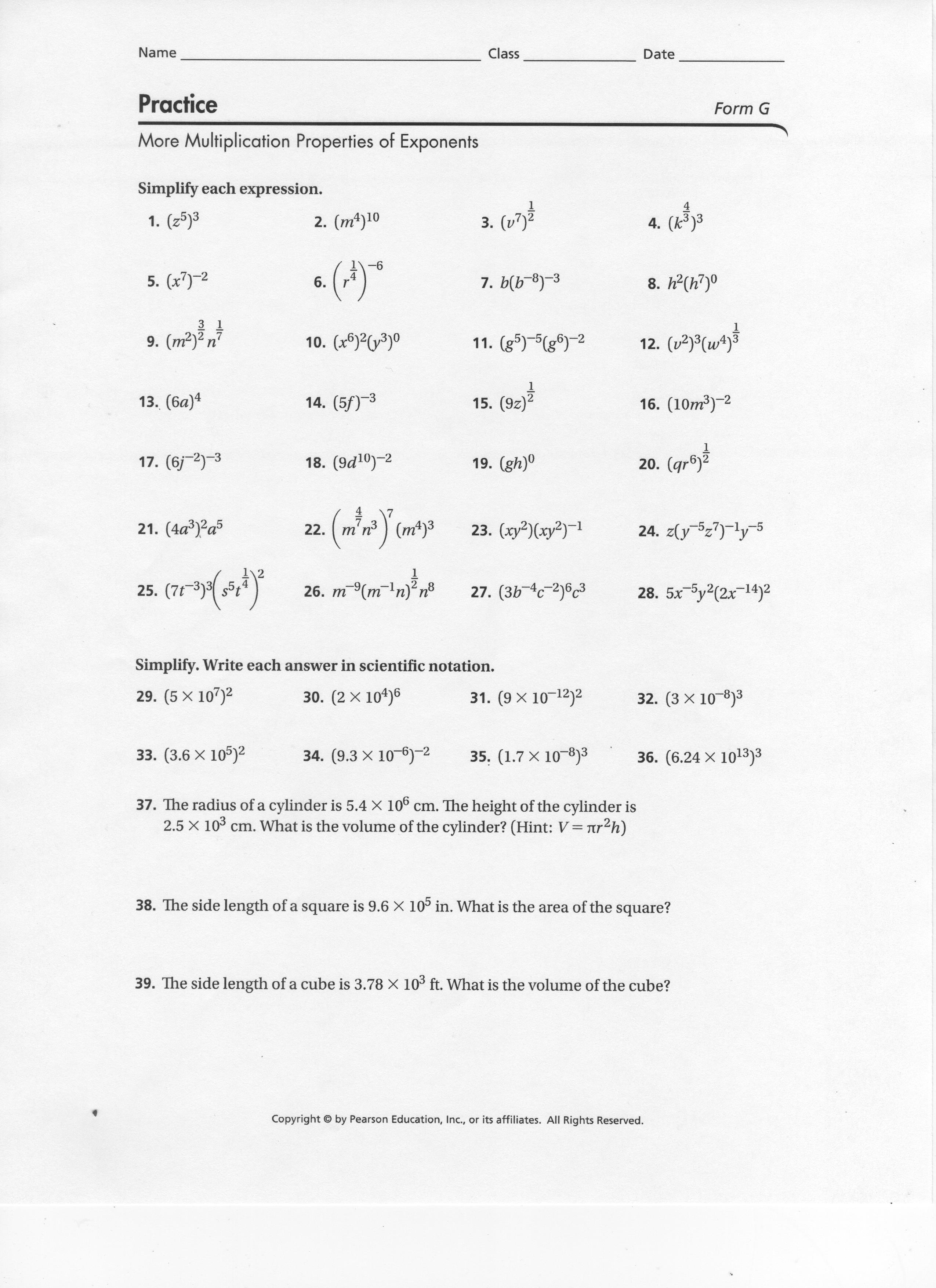
As a parent, I know how important it is to find engaging and effective resources for my child's learning journey. Sometimes, a simple properties of exponents worksheet can be a game-changer, offering a focused practice tool for a specific math concept. It's like having a personal tutor guide your child through the intricacies of properties of exponents, and it's a great way to reinforce those algebra 1 skills.
Practice with exponent expressions and properties.

Mastering Exponent Properties: A Comprehensive Guide
Exploring Different Worksheet Types
When it comes to mastering exponent properties, having a variety of worksheet types at your disposal is key. While a basic properties of exponents worksheet offers focused practice on specific rules, there are also more advanced worksheets that delve into real-world applications and complex scenarios. These advanced worksheets challenge students to apply their knowledge of exponent rules in practical contexts, fostering a deeper understanding of the topic.
For instance, a worksheet focused on properties of exponents might include questions that require students to manipulate and simplify expressions involving negative exponents or to apply the product rule, quotient rule, and power rule to solve more intricate problems. By encountering a range of questions and scenarios, students develop the skills needed to tackle any exponent-related challenge they may face.

Multiplying powers with the same base.
People Also Ask: What Are Some Common Exponent Rules Covered in These Worksheets?
One of the most fundamental concepts covered in properties of exponents worksheets is the product rule. This rule states that when multiplying two numbers with the same base, you can simply add their exponents. For example, $x^3 \cdot x^5 = x^{3+5} = x^8$. Understanding and applying this rule is crucial for simplifying expressions and solving equations.
Another important rule is the quotient rule, which applies when dividing two numbers with the same base. According to this rule, you subtract the exponent of the divisor from the exponent of the dividend. So, $x^7 \div x^2 = x^{7-2} = x^5$. This rule is essential for simplifying fractions and solving problems involving division.
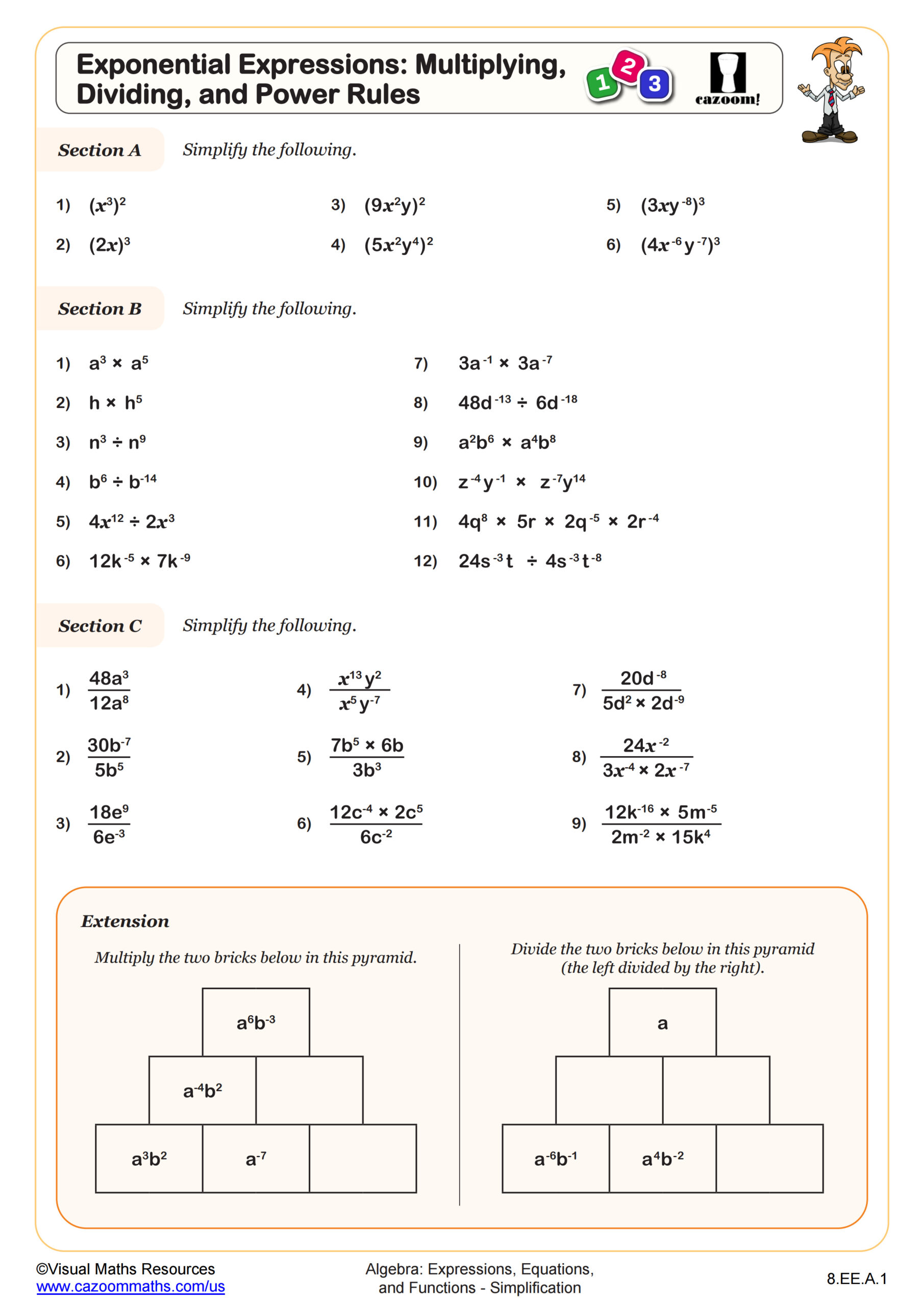
Applying the product rule for exponents.
Additionally, the power rule is a fundamental concept that states when raising a power to a power, you multiply the exponents. For instance, $(x^3)^5 = x^{3 \cdot 5} = x^{15}$. This rule is particularly useful when dealing with nested exponent expressions and can simplify complex calculations.

Exponent rules for grades 6-8.
How to Effectively Use and Print Properties of Exponents Worksheets
Printing and using properties of exponents worksheets is a straightforward process that can greatly enhance your child's learning experience. Here's a step-by-step guide:
- Select the Right Worksheet: Choose a worksheet that aligns with your child's grade level and learning goals. For instance, if they're in grade 8 or 9, opt for a worksheet specifically designed for their age group, such as the properties of exponents worksheet grade 8 or properties of exponents worksheet grade 9. These worksheets will cover the appropriate level of difficulty and cater to their specific learning needs.
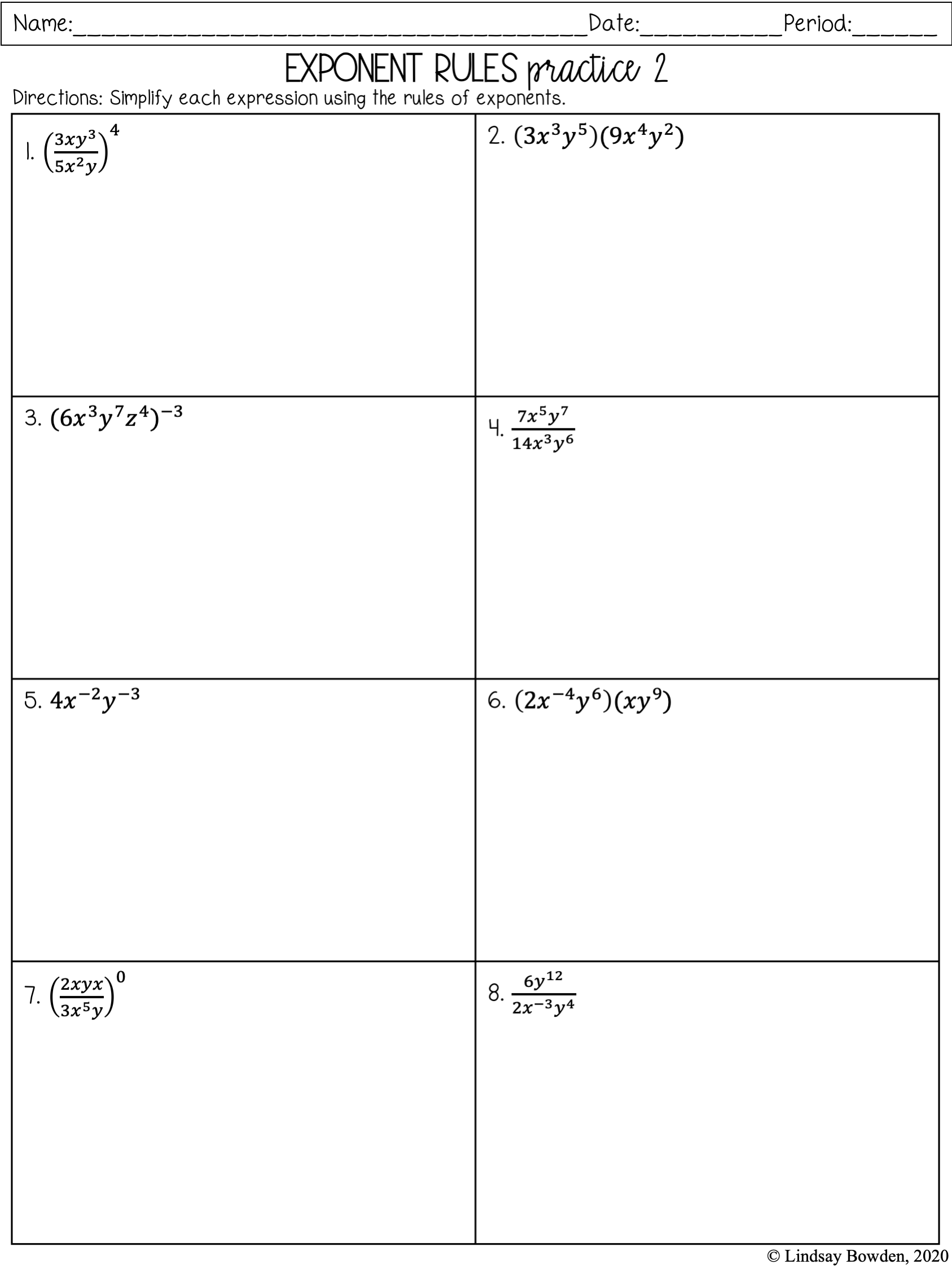
Free practice with exponents.
- Print and Prepare: Once you've found the ideal worksheet, print it out or display it on a device. If printing, ensure you have sufficient ink and paper to avoid interruptions during the learning session.

Multiplying exponents with whole numbers.
- Create a Comfortable Learning Environment: Set up a dedicated study area with minimal distractions. Having a quiet and comfortable space will help your child focus and engage with the worksheet effectively.

Solving equations with exponents and integers.
- Explain and Guide: Before your child starts working on the worksheet, take a few minutes to explain the concept of exponent properties. Provide clear and simple definitions, and offer examples to illustrate the rules. This introductory step will help them understand the purpose and importance of the worksheet.

Algebra 1: exponent rules and practice.
- Encourage Active Learning: As your child works through the worksheet, encourage them to ask questions and explore different strategies. Guide them through the initial problems, and then allow them to attempt the remaining questions independently. This approach fosters critical thinking and problem-solving skills.

Exponent rules practice for all levels.
- Review and Provide Feedback: Once your child has completed the worksheet, review their work together. Correct any mistakes and provide constructive feedback. Highlight the areas where they excelled and offer suggestions for improvement. This feedback loop is essential for reinforcing learning and building confidence.

Fractions with exponents and radicals.
- Practice Regularly: Consistency is key when it comes to mastering exponent properties. Encourage your child to practice regularly, even if it's just for a few minutes each day. Regular practice will help them retain the concepts and build a solid foundation.

Solving integers with exponents and radicals.
Progressive Practice: From Simple to Challenging
Properties of exponents worksheets often follow a progressive structure, allowing learners to build their skills gradually. Starting with basic concepts, these worksheets introduce the fundamental rules of exponents, such as the product rule and quotient rule. As learners gain confidence, the worksheets progress to more complex scenarios, incorporating negative exponents and the power rule.
For instance, a beginner-level worksheet might focus on simplifying expressions like $x^3 \cdot x^5$ or $x^7 \div x^2$, where the base is the same and the exponents are relatively small. As learners advance, they encounter more intricate problems, such as $(x^3)^5$ or $x^{-2} \cdot x^{3}$, which require a deeper understanding of exponent properties and their applications.

Fractional exponents and radicals practice.
This progressive approach ensures that learners can grasp the basics before tackling more challenging concepts. It allows them to build a strong foundation, which is essential for mastering more advanced mathematical topics in the future.
Real-World Applications: Connecting Exponent Rules to Practical Scenarios
While properties of exponents worksheets often focus on theoretical concepts and rules, it's important to connect these ideas to real-world applications. Exponent rules are not just abstract mathematical concepts; they have practical uses in various fields, including science, engineering, and everyday life.
For example, when calculating the volume of a cube, you need to understand exponent rules. The volume of a cube is calculated as $s^3$, where $s$ is the length of the cube's side. Similarly, when dealing with exponential growth or decay in science or economics, understanding exponent rules is crucial for making accurate predictions and interpretations.
By incorporating real-world examples into properties of exponents worksheets, learners can see the practical relevance of these concepts. This connection not only enhances their understanding but also motivates them to master exponent rules, knowing that these skills are applicable beyond the classroom.
So, you've got a great selection of exponent worksheets to choose from, and now it's time to put your skills to the test! These resources are a fantastic way to reinforce your understanding and apply those exponent properties in a practical manner.
Why not grab a worksheet, find a quiet spot, and give it a go? It's a fun way to challenge yourself and see the real-world applications of these mathematical concepts. Leave a comment or share your experience below; we'd love to hear how you get on!
Solving equations with exponents and variables.

Read also: 29 Sight Word Worksheets for Early Readers